
Healthcare
A visit diary is clinical data.
Frequency, address and practitioner type reveal diagnoses, care intensity and vulnerability — before a single clinical note is read.
Not another booking SaaS. Sovereign workflow infrastructure for any organisation that coordinates people in the field — healthcare, field services, government, utilities, logistics, security and financial or professional services. Deployed inside your own boundary as a module of the PSCE platform.
Sovereign appointment booking flow
A booking request is raised in the client app from a saved location against live slots. It travels to a coordinator, who can approve, modify or reassign it — on approval the slot locks. The approved visit syncs to the field calendar as part of the rota, where double-booking is impossible, and is then delivered using sovereign routing with nothing logged onward. Every stage runs inside your environment.
Appointment data stays within your designated deployment boundary.
Everyone else says “book online in seconds.”
Pryvate says your diary is not our dataset.
Every hand-off between tools is an integration to maintain, a contract to renew and a gap in the record.
One deployment boundary.
One audit trail.
One accountable infrastructure layer.
Before anyone opens a file, the diary has already said too much.
Frequency, address and practitioner type reveal diagnoses, care intensity and vulnerability — before a single clinical note is read.
An adviser repeatedly visiting one family office, or a restructuring team booked into a struggling issuer, is exactly the signal MiFID II recordkeeping exists to govern.
Where inspectors will be, which addresses receive welfare visits and how teams are deployed carries direct operational and personal-safety consequences.
Mainstream scheduling platforms typically require appointment and operational metadata to be processed within the provider's cloud environment. Pryvate is designed differently: the infrastructure, deployment model and data boundary remain under organisational control. Who meets whom, how often and where is a behavioural map of your organisation.
third-party data processors in the booking path — by architecture
disconnected systems consolidated into one governed workflow
contract, SDK and audit trail from booking to completion
of appointment data held within your deployment boundary
Architectural guarantees, not performance benchmarks — each is verified with you during the assessment.
The realistic alternative isn't one competitor — it's all six of these, stitched together, each seam a sub-processor and a compliance question.
Six separate systems — Booking & appointment SaaS, Staff rota software, SMS / email notification gateway, Consumer messaging apps, Global map & routing APIs, Field tracking application — converge into a single governed workflow, Scheduling & Field Coordination on PSCE. Five of the six are third-party sub-processors and one, consumer messaging, is ungoverned entirely.
Scheduling & Field Coordination on PSCE
Scheduling is a module of the Pryvate Secure Communications Engine. It shares PSCE's identity, encryption and data-residency guarantees — and composes natively with Location Intelligence for routing, geocoding and live tracking.
Three client surfaces — a white-label client app, a field app and a coordinator console — call into your own PSCE tenant, in your own jurisdiction. Inside that boundary sit four modules: the scheduling engine, Location Intelligence, encrypted messaging, and audit and residency. Global calendar clouds, map APIs, SMS gateways and analytics trackers sit outside the boundary and are not in the path.
Client app
Booking flows, addresses, reminders, ratings — white-label iOS / Android / web
Field app
Agenda, calendars, navigation, visit documentation — tablet & mobile
Coordinator console
Rotas, approvals, oversight, requests, audit
Scheduling engine
Rotas, availability, approvals, lifecycle, timezone logic
Location Intelligence
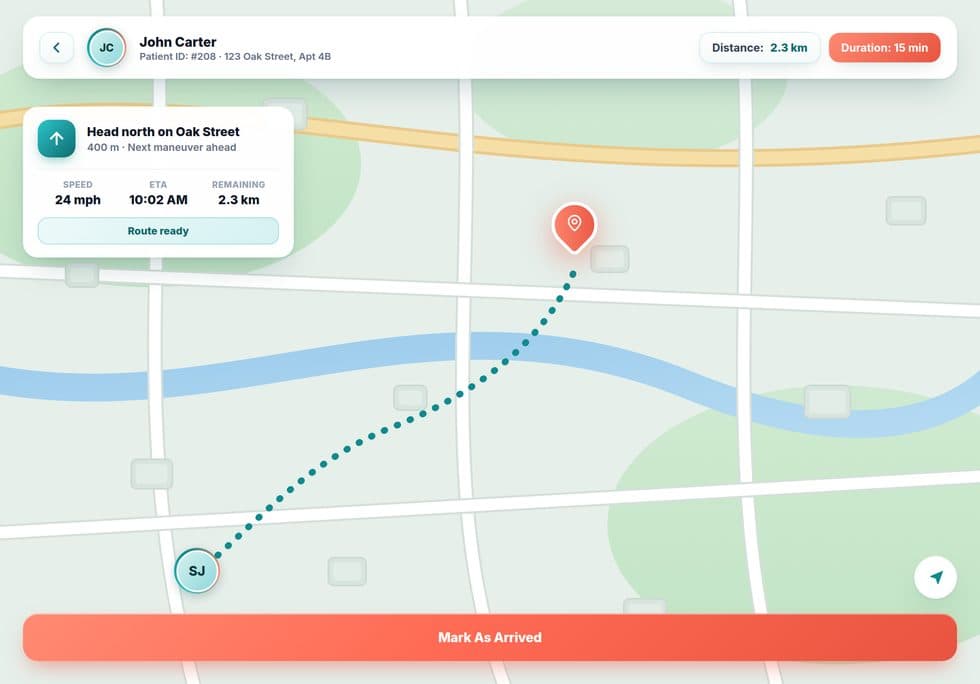
Geocoding, routing, geofencing, ETA
Encrypted messaging
Reminders, updates, coordinator chat
Audit & residency
Event log, retention policy, compliance export
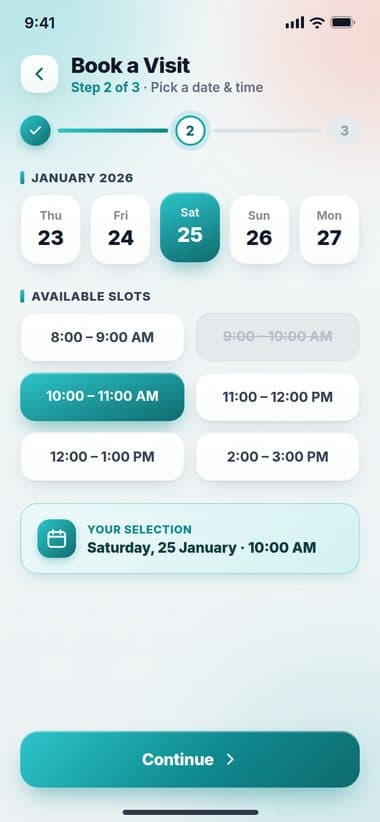
Guided multi-step flows — profile, location, live slots, intake notes — in your own apps, including on behalf of others.
Clients see only slots the rota can actually serve — timezone-aware, served from your tenant.
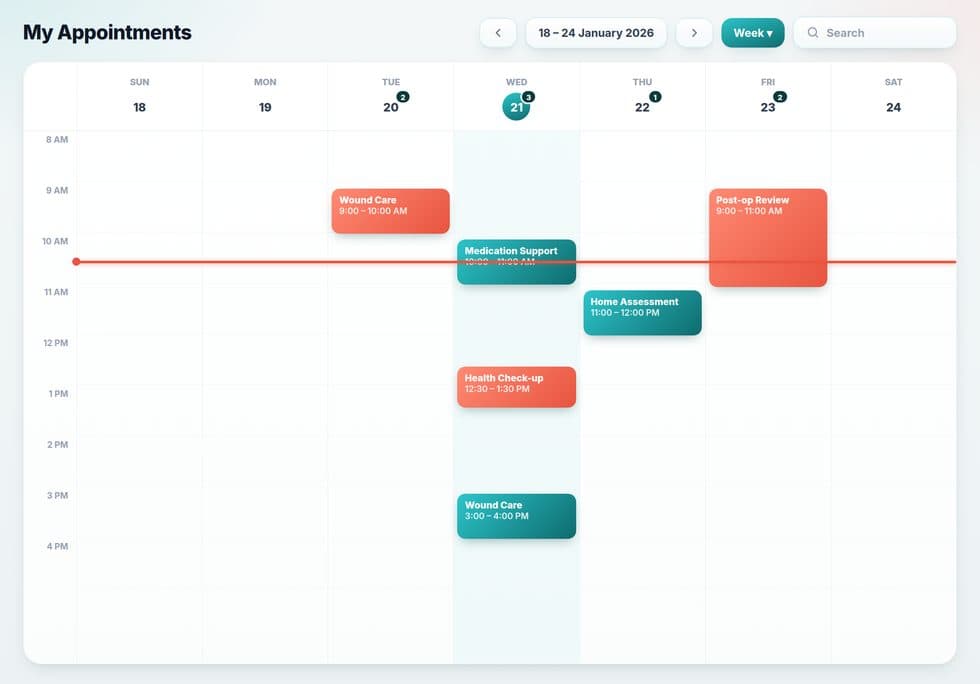
Coordinators manage working schedules and availability for every field worker from the admin console.
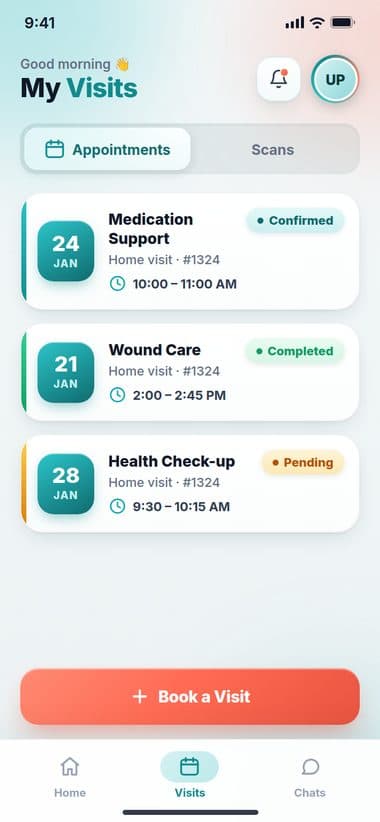
Every request is reviewed: approve, reject, modify or reassign. On approval the slot locks.
Rebalance visits by availability, workload and proximity — without breaking the audit trail.
Approved visits sync straight to staff calendars — day, week and month, with workload badges.
Full state history from request through to completion.
End-to-end encrypted location sharing and arriving-soon alerts via Location Intelligence.
Saved service locations and recipient profiles with map-pin capture, geocoded in-boundary.
Integrated encrypted chat between coordinators and clients — negotiate times, confirm details.
Delivered over PSCE encrypted channels — no SMS gateways, no cleartext.
The same unified PSCE SDK — add scheduling to existing apps in weeks.
Reference implementations for client booking and field delivery, ready to white-label. Healthcare configuration shown — terminology, workflows and branding adapt per sector.
This is one configuration, not the product. The same engine runs dispatch boards, inspection rounds, maintenance schedules and client meetings — the labels change, the infrastructure does not.
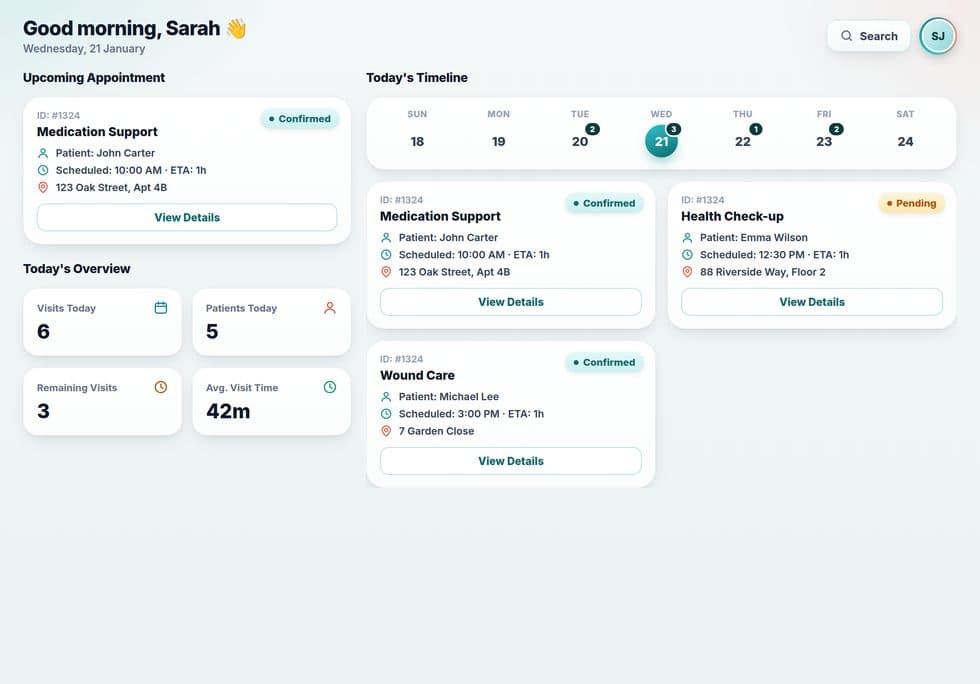
How the module is designed to be used, in three deployments.
Replacing a US-cloud booking SaaS for nurse home visits, so patient addresses and visit patterns never leave the provider's own tenant.
Client meetings booked and confirmed over encrypted channels — no external calendar metadata to account for.
Air-gapped deployment scheduling inspections with sovereign routing and offline-tolerant field sync.
Named references are available under NDA through your account team.
Built for sectors where the diary itself is sensitive. Labels, workflows and roles are configured per deployment; select a sector to see how.
Who is being visited, how often, at what address and by which specialism reveals diagnoses, care intensity and vulnerability — before a single clinical note is read. Under GDPR and HIPAA-aligned regimes, an appointment book of home visits deserves the same protection as the record itself. Mainstream booking SaaS, SMS reminder gateways and consumer map APIs each become a sub-processor of that data.
| Platform concept | In your language |
|---|---|
| Service recipient | Patient |
| Field professional | Nurse / Carer |
| Coordinator | Care coordinator |
| Assignment | Home visit / Clinic round |
| Service location | Patient home address |
| Completion record | Visit record & escalations |
Rota-driven availability
Patients only ever see slots the nursing rota can actually serve.
Coordinator approval
Every booking is clinically triaged before it is confirmed — no unsupervised self-serve.
Live ETA for patients
“Your nurse is 15 minutes away” — end-to-end encrypted, no location broker involved.
Escalation trail
Clinical concerns raised during a visit are captured and routed with full audit.
Family booking
Carers and relatives can book and manage visits on behalf of a patient profile.
Encrypted reminders
Appointment reminders over PSCE channels — no PHI in SMS gateways.
Deployment fit — Most care providers deploy Private Cloud or On-premises alongside their PSCE tenant; NHS-aligned and sovereign estates are individually scoped.
Managed within Pryvate's sovereign infrastructure. Fastest to live.
Your cloud account, your region, your keys — operated with our tooling.
Deployed inside your data centre alongside your PSCE tenant.
Fully disconnected estates with offline-tolerant field sync.
Accredited environments, sovereign hosting and clearance-ready support.
1,000+ users, dedicated tenant, audit and compliance tooling.
An enterprise module, priced like one.
Scheduling is licensed as an enterprise PSCE module — one contract, one SDK, no new data processors.
Enterprise and sovereign deployments are configured around organisation size, infrastructure requirements and deployment model. Packaged deployments are available for smaller organisations.
No. It runs the operational scheduling of visits inside your boundary. Read-only sync to corporate calendars is available where your policy allows — the system of record stays in your tenant.
Yes. Scheduling ships as SDK modules and APIs for your existing iOS, Android and web apps, plus white-label reference apps for a faster start.
Appointment content and operational metadata remain within your designated deployment boundary. That boundary is defined per deployment model: for on-premises and air-gapped estates it is your own infrastructure; for managed deployments Pryvate operates it and holds only the limited operational data needed to run and support the service. In every model, your data is never used for advertising, profiling or unrelated analytics.
Timelines are confirmed during the workflow and security assessment — managed-cloud tenants are fastest; on-premises and air-gapped estates are scoped during technical evaluation.
Yes — that's the default. Requests route to a coordinator who can approve, reject, modify or reassign before anything is confirmed. Fully self-serve confirmation can be enabled per workflow if you prefer.
Booking, availability and lifecycle work standalone. Live ETA, tracking and field navigation compose with the Location Intelligence module — most scheduling customers deploy both.
Security review still open? Request the security whitepaper.
Scheduling & Field Coordination is not a secure version of a booking app. It is one layer of the PSCE platform, for organisations whose appointments, people and operating patterns cannot safely pass through a collection of third-party platforms.
Modules of one platform — one boundary, one contract, extended a module at a time.
AI and operational intelligence are on the roadmap — the same boundary, the same guarantees.
Explore PSCE — the core platform underneath every module, including Location Intelligence.